Category: Uncategorized

  • Custom Balloon Printing: How to Specify Colors, Sides, and Artwork That Prints Clean

    Custom Balloon Printing: How to Specify Colors, Sides, and Artwork That Prints Clean

    Most problems with a custom balloon order do not happen on the balloon. They happen in the half hour before you place the order, when a logo gets attached to an email with no thought about how it will be screened, sized, or registered on a curved surface that changes shape as it inflates. Getting that part right is the difference between a crisp imprint and a blurry blob that only your printer can love. This walkthrough covers the decisions a buyer actually has to make, in the order they come up.

    The short version: pick a print method that matches the balloon material, decide how many ink colors you truly need, size the artwork to the printable window for that balloon, choose one side or two, and submit clean vector files. Do those five things and a balloon order is one of the easier promotional items to buy.

    Screen print or digital: the method follows the material

    Latex balloons are almost always screen printed. A rubber plate carries your design, ink is pressed onto the deflated or lightly inflated balloon, one color at a time. Screen printing uses spot inks, meaning each color is a specific premixed ink laid down through its own screen. It is fast, durable, and cheap at volume, but it is built for solid shapes and bold lines rather than photographs or subtle gradients.

    Foil, or mylar, balloons are a different animal. Because the surface is a flat film before inflation, many suppliers now offer digital full-color printing on foil, which prints a photographic image or a multicolor gradient in a single pass with no per-color screens. If your brand mark is a two-color logo, latex is the natural home. If you need a full-color photo, a gradient, or a design with more than three or four colors, ask specifically about digitally printed foil instead of trying to force it onto latex.

    How many colors you need, and why each one costs more

    On screen-printed latex, every ink color is a separate screen that has to be made, mounted, and registered to line up with the others. That is why pricing jumps at each color count: a one-color imprint is the baseline, two colors is common and widely available, and three- or four-color spot designs exist but carry more setup and tighter registration tolerances. Small misalignment that would be invisible on a flat card becomes obvious when it stretches across an inflating sphere, so printers keep multicolor latex designs simple on purpose.

    A practical rule: if your logo can be reduced to one or two solid spot colors without losing its identity, do that. You will pay less in setup, get faster turnaround, and avoid registration risk. Reserve full color for foil, where it is printed digitally and the color count does not drive the price the same way. Standard ink shows best on lighter balloon colors; a light ink on a dark balloon may need a specific opaque ink, so confirm ink choice against your balloon color rather than assuming any combination works.

    Sizing artwork to the print area

    Every balloon has a printable window, and it is smaller than people expect because a balloon is only printed on the flat panel that faces the press. Published spec sheets across the industry land in a consistent range. A 9-inch round typically prints inside about a 4.5-inch diameter, an 11-inch round around 4.75 inches, and 16- to 17-inch rounds roughly 6 inches high or wide. Only the big 36-inch balloons open up real estate, on the order of 12 inches tall by 15 inches wide. Heart shapes run smaller, near 4.75 inches on an 11-inch heart and about 7 inches on a 17-inch heart. Treat these as indicative; each manufacturer publishes its own exact template, and you should design to the one your printer sends.
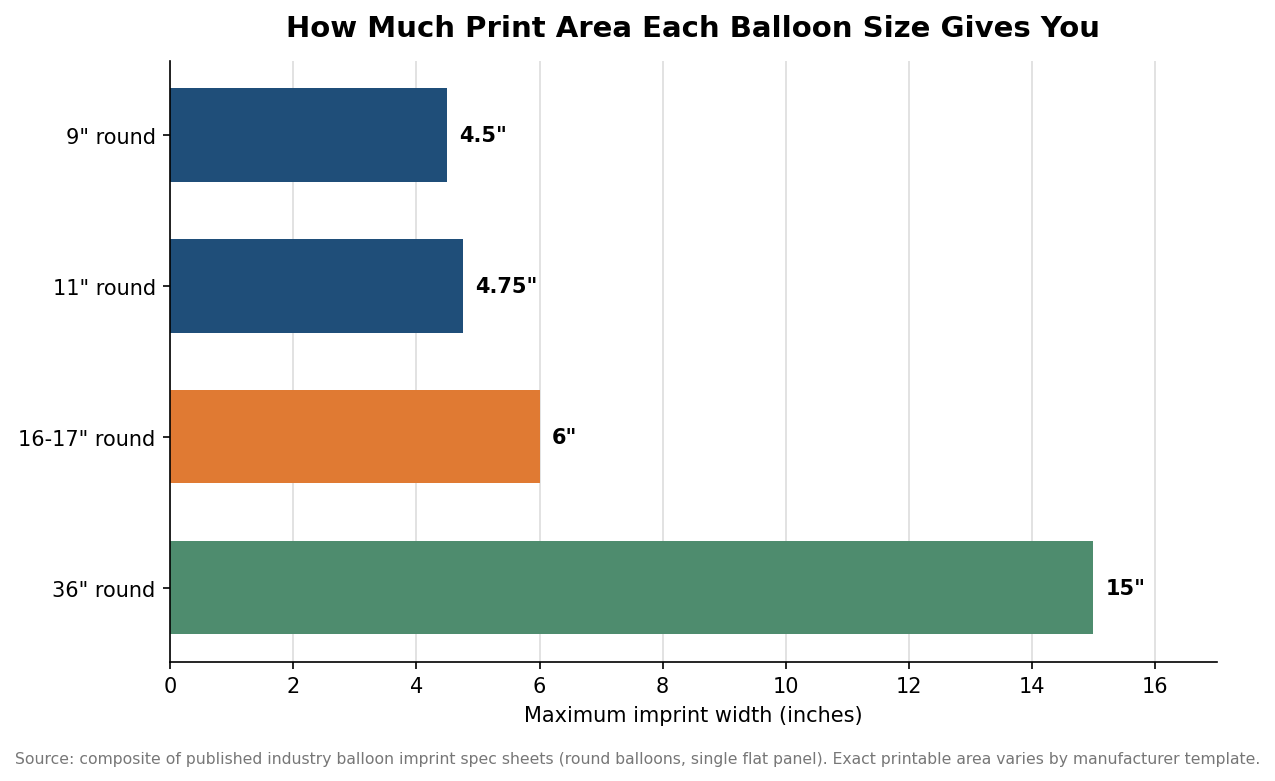
    Horizontal bar chart of maximum imprint width in inches by balloon size, from 9-inch to 36-inch round balloons
    Approximate printable width by balloon size; exact templates vary by manufacturer.

    The second thing to understand about sizing is distortion. A balloon is printed flat or barely inflated, then the image expands with the balloon. Art that looks tight on the template spreads and lightens once the balloon reaches full size, which is usually what you want. The trap is underinflation: a balloon filled short of its rated size shows a shrunken, squeezed logo. If the display matters, inflate to the size the print was designed for. Keep copy to a few short lines, avoid tiny type, and give artwork room to breathe rather than cramming the window edge to edge.

    One side, two sides, and the setup math

    A one-side imprint is the default and covers most needs, since a balloon rotates freely and rarely faces a viewer for long. Printing the second side roughly doubles the press work and adds cost, quoted either as a per-balloon add-on on larger sizes or through a higher minimum on smaller ones. It is worth it for a stage backdrop or a photo wall where balloons are anchored and the back is visible; it is usually wasted on giveaways.

    Beyond the sides decision, a few one-time and per-change fees shape the total. Screen setup is charged per design and varies by balloon size; changing an ink color mid-run can add a smaller fee; a second side adds a per-balloon amount on big balloons; and rush production carries its own charge. None of these are large individually, but they explain why a tiny reorder with a color tweak can feel disproportionately expensive. Your quote itemizes any of these that apply to your design.

    Minimums track balloon size and method. At Get Custom Balloons, orders start from 12 balloons; two-sided jobs and very large balloons can change the minimum, so your quote confirms it. Build your quantity around the event plus a spoilage cushion, because balloons do burst and a handful will be lost to inflation and handling.

    File setup that prevents a reprint

    The single most common cause of delay is artwork that is not production ready. Printers want vector files built in Illustrator or supplied as EPS or PDF, because vector art scales to the balloon template without pixelating. Convert all fonts to outlines or curves so the printer does not need your typeface, keep type at roughly 4 points or larger since anything smaller fills in on latex, and set lines and outlines to about 1 point or heavier so they survive the press. If you only have a raster logo, supply it at high resolution and expect the printer to recreate it as vector, which takes time and sometimes a fee.

    Always approve a proof before production. On a curved, stretching surface, the proof is where you catch a logo that sits too low, a color that reads differently against the balloon than it did on your monitor, or copy that will distort at full inflation. Approving the proof also starts the production clock: standard production ships in about 2 weeks after approval, and faster turnaround is available with express shipping. Plan backward from your event date, add the proof cycle, and you will not be chasing a delivery the week of the party.

    Specify the method to the material, keep the color count honest, design to the real print window, choose sides deliberately, and hand over clean vector files. That sequence is the whole job, and it is what separates an order that arrives looking sharp from one that arrives looking like a compromise.
  • Latex, Foil, or Bubble: Choosing the Right Custom Balloon Material

    Latex, Foil, or Bubble: Choosing the Right Custom Balloon Material

    Custom balloons come in three materials that behave nothing alike, and choosing the wrong one is how a brand ends up with deflated logos before the doors open, or a bin full of foil after a single afternoon. Latex, foil, and bubble balloons differ in how long they hold helium, how your artwork prints, how they look inflated, what they cost per piece, and how they are thrown away. Treat the choice as a spec decision rather than a color decision and the rest of the order gets easy. Here is how the three compare on the points that actually matter.

    Latex: natural rubber, printable, and biodegradable

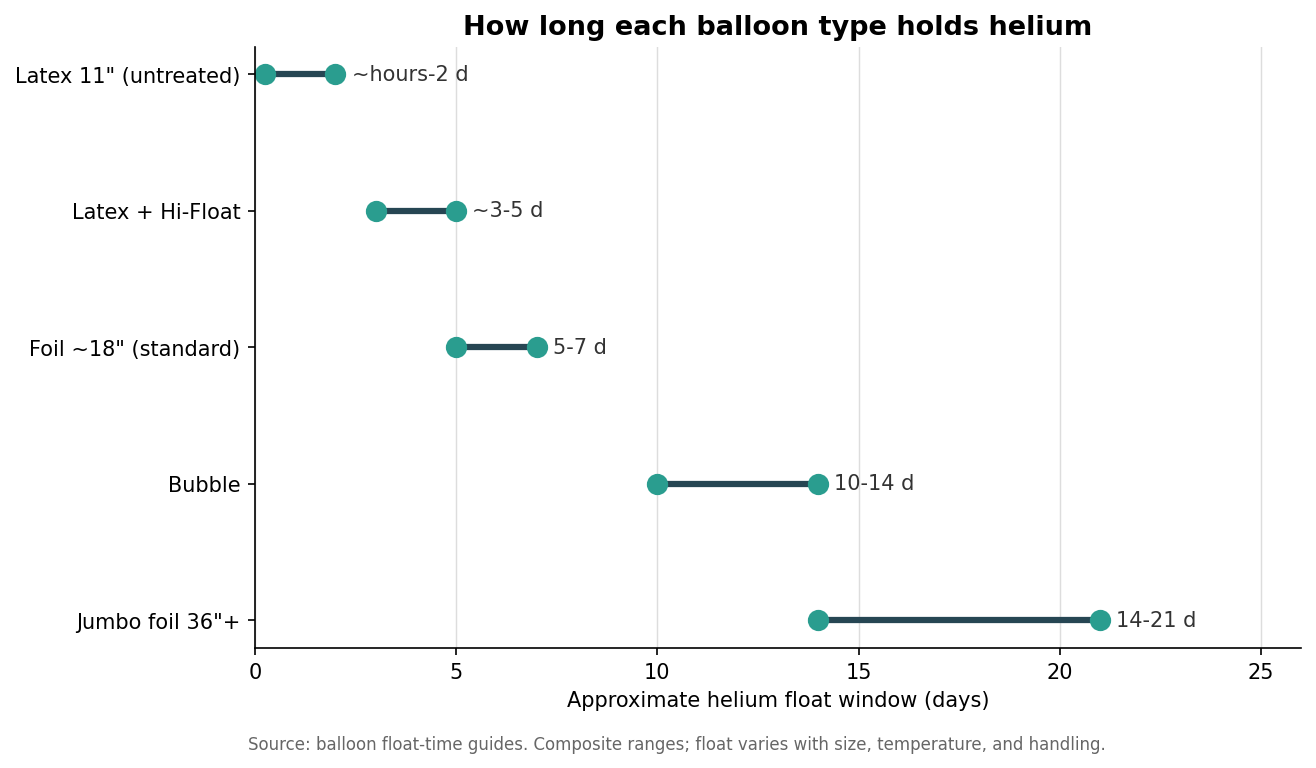
    Latex is the workhorse of promotional balloons. It is made from natural rubber, which means genuine latex biodegrades over time rather than lingering the way plastics do — the only compostable option of the three. It screen-prints cleanly with a logo, comes in a standard ladder of sizes (commonly 9, 11, 14, 17, 24, and 36 inches, with the 11-inch as the default), and carries the lowest unit cost by a wide margin. The trade-off is helium retention: an untreated latex balloon holds a float for only a few hours up to about two days. A gel coating applied inside the balloon (sold under names like Hi-Float) slows the leak and buys several more days. Print minimums tend to be higher on latex because each run is set up individually, so it rewards volume. Latex also inflates to different diameters depending on how much helium or air you put in, which is a detail worth remembering when you are sizing a garland or matching balloons across a display — the same 11-inch balloon can look noticeably different under- versus fully inflated. For most promotional work, the combination of low cost, clean printing, and compostability makes latex the starting assumption unless a longer float or a specific shape pushes you elsewhere.

    Range chart of approximate helium float window in days for latex, foil, and bubble balloons
    Approximate helium float window by balloon type (composite ranges).

    Foil (mylar): holds helium for days to weeks

    Foil balloons — also called mylar — are made from a metallized nylon film that barely lets helium escape, which is their whole advantage. A standard 18-inch foil floats roughly five days to a week, and jumbo shapes hold two to three weeks. They come as numbers, letters, and molded shapes, take a printed logo, and give that reflective metallic finish. Two caveats decide whether they fit: they cost more per piece than latex, and they are not biodegradable, so they have to be deflated and thrown away rather than released — a released foil balloon is also a genuine hazard around power lines. Minimums are often lower than latex, which makes foil practical for smaller runs where the display needs to survive several days. Foil also self-seals at the valve, so it can be inflated, deflated, and often re-inflated for a repeat use — a real advantage for a recurring event or a reusable storefront piece, where a latex balloon would simply be discarded after one outing.

    Bubble and specialty balloons

    Bubble balloons are the newest of the three: a stretchy, transparent plastic (often a polyurethane film) blown into a rounded, three-dimensional clear sphere that can be filled with confetti or nested around a second balloon. They hold helium for about ten days to two weeks, splitting the difference between standard and jumbo foil. The look is premium and photograph-friendly, and the price matches — these are centerpiece balloons, not giveaway quantities. Like foil, the plastic film is not biodegradable and belongs in the trash after use. Reach for bubble balloons when a single striking display matters more than covering a room.

    How the material changes your custom order

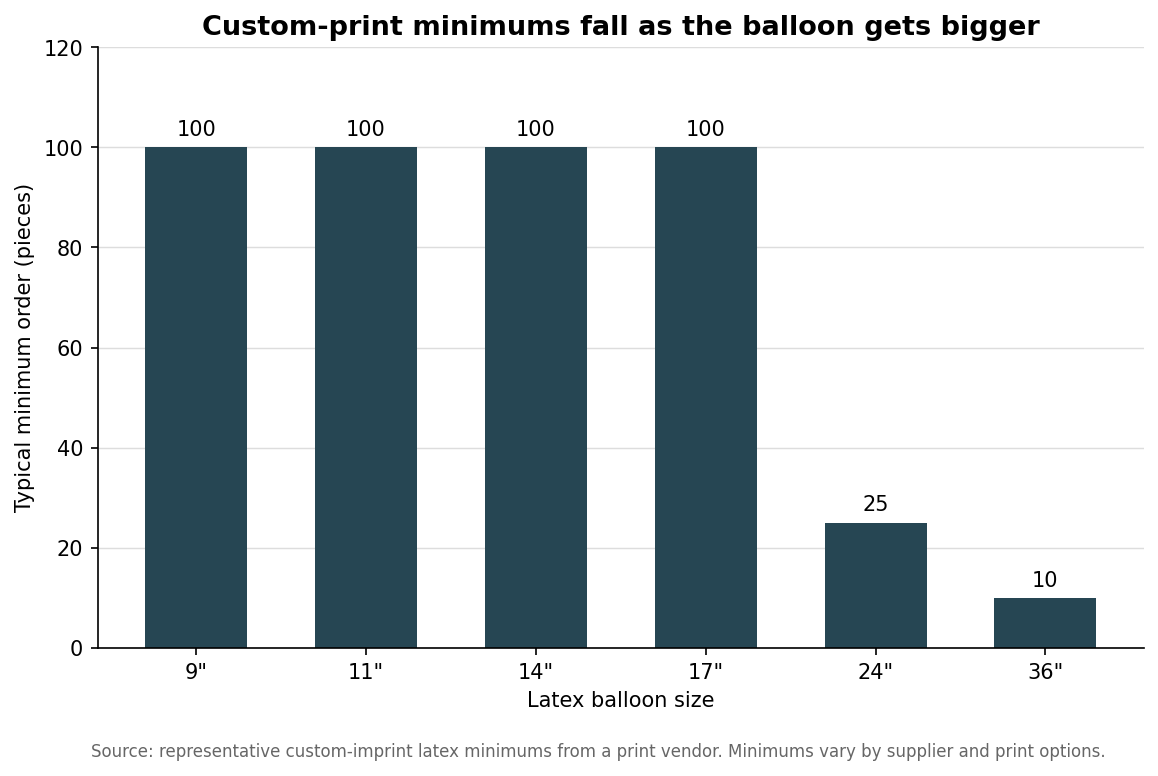
    The print spec rides on the material. On latex, a single color printed on one side is the economical default; adding a second side or a second ink color raises both the price and the minimum quantity you have to order, because each combination is a separate setup. Print area scales with balloon size — a bigger balloon carries a bigger mark — but a balloon is only fully round at its rated inflation, so artwork has to be sized to the inflated diameter or the logo stretches and distorts. Most print pricing bundles the setup and ink into the per-run cost, and standard production at Get Custom Balloons ships in about 2 weeks after mockup approval, with faster turnaround available through express shipping. One useful pattern in the minimums: the larger the balloon, the fewer you have to buy, because the big sizes are ordered in far smaller counts.

    Bar chart of typical custom-print minimum order quantities by latex balloon size
    Typical custom-print minimums by latex size; they fall as the balloon grows.

    Choosing by float window, print, and disposal

    The decision comes down to three questions. How long does it need to float, what does the artwork require, and how will it be disposed of? If you need a lot of branded balloons for a single day at the lowest cost, latex is the answer, and it is the choice if compostability is on your checklist. If the display has to last a week or more, or you need a specific number or shape, foil earns its higher unit price by not deflating. If you want one premium, three-dimensional centerpiece for photos, a bubble balloon delivers a look the other two cannot. Many of the best displays mix materials — a latex garland anchored by a foil milestone number, say — so you are rarely locked into one. Whatever the mix, confirm the inflated diameter, the number of print sides and ink colors, and the lead time before you place the order, and the balloons that arrive will be the ones you pictured.

  • Balloon Sizes Explained: What Each One Is For and How Big Your Logo Prints

    Balloon Sizes Explained: What Each One Is For and How Big Your Logo Prints

    Balloons are sold by a number printed on the bag, and almost everyone assumes that number is the size they will get. It is not. A balloon’s stated size is the diameter it reaches at full inflation, and most balloons are deliberately filled a little short of that so they keep a round shape instead of a stretched, pear-like one. If you are ordering custom balloons for an event or a brand, that gap between the label and the finished size ripples into everything downstream: how many you need, how big your logo can print, and how much helium the job will burn. This is a size-by-size guide to choosing the right balloon before you commit to a printed order.

    The number on the bag is not the size you get

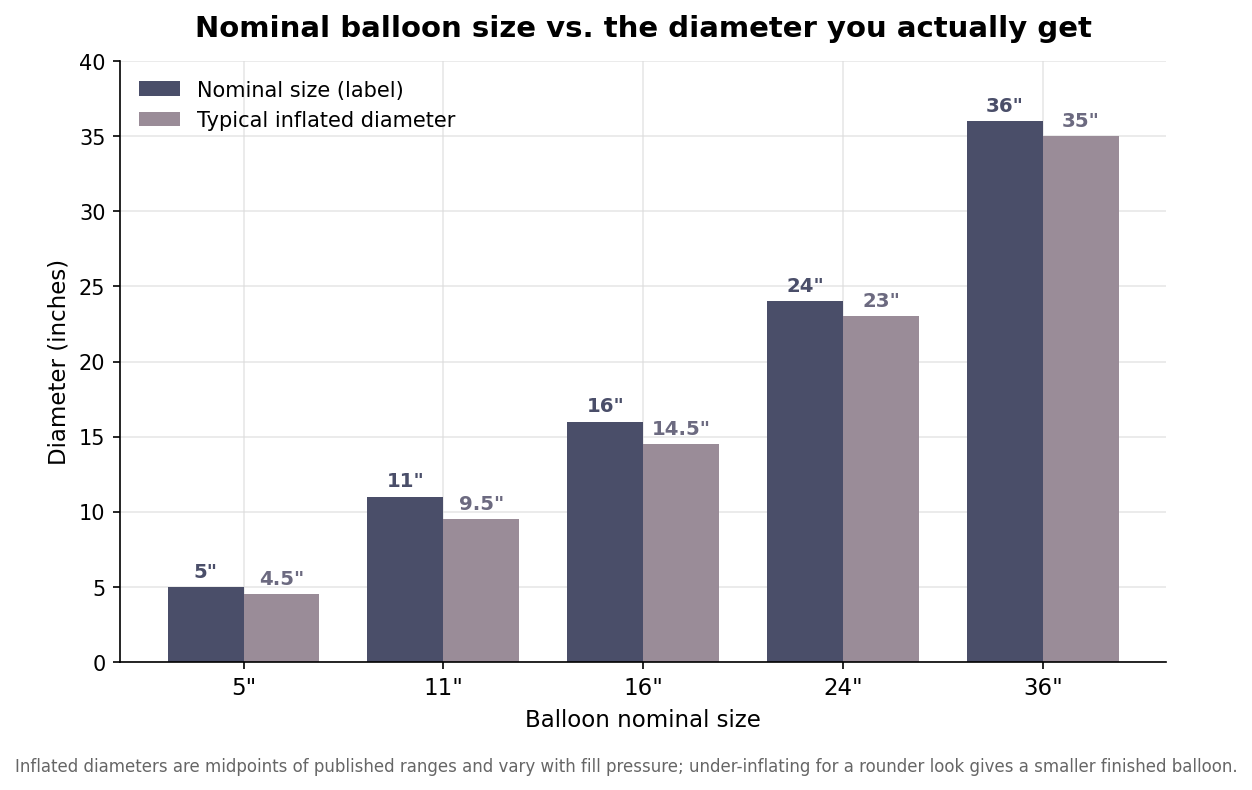
    Balloons are measured at maximum inflation. An 11 inch balloon means the latex can stretch to about 11 inches across, but a well-formed 11 inch balloon is usually filled to roughly 9 to 10 inches so it stays round and durable. The same holds all the way up the range: a 5 inch balloon finishes around 4 to 5 inches, a 16 inch around 14 to 15, a 24 inch around 22 to 24, and a 36 inch giant around 34 to 36. The practical lesson is to plan your spacing, your quantities, and your backdrop coverage around the inflated size you will actually work with, not the label, because the difference between an 11 inch label and a 9 inch finished balloon adds up quickly across a wall of a few hundred.

    Grouped bar chart comparing nominal balloon label size to typical inflated diameter for 5, 11, 16, 24 and 36 inch balloons
    The label size is the maximum; balloons are usually filled a little short of it.

    What each size is actually for

    Each size has a job it does best. Five inch balloons are fillers: they add texture and detail packed into organic garlands, balloon walls, and the gaps in an arch, and they are meant to be air-filled rather than heliumed. Eleven inch balloons are the industry standard and the most versatile choice, the default for bouquets, classic arches, and general decor, and the size most custom printers treat as their bread-and-butter for logo work. Sixteen inch balloons add dimension when mixed with smaller sizes and carry a bigger, bolder print. Twenty-four inch balloons become statement pieces for entrances, backdrops, and photo moments, while thirty-six inch giants are focal points, often filled with confetti or printed with a single large message. Mixing two or three sizes is what gives a professional installation its sense of depth; a wall built from one size reads flat.

    How balloon size decides your print area

    Custom printing is where size choice gets concrete for a brand. On the standard 11 inch latex balloon, a typical single-side imprint occupies about a 5 inch circular area, printed in up to two ink colors by screen or pad printing, with the option to print one or both sides. That is enough room for a logo and a short line of text, but not for dense detail, so simple, high-contrast artwork reproduces best on the curved, stretchy surface. Stepping up to a 16 inch balloon buys you a noticeably larger canvas for more elaborate logos or longer messages, which is the main reason event brands move up a size rather than for the extra height alone. Two points are worth confirming with any printer before you order: that your artwork fits their stated imprint area at the balloon size you have chosen, and how the print looks when the balloon is inflated to working size rather than fully stretched, since over-inflation distorts and lightens a printed logo.

    Helium math: why bigger balloons cost more to fill

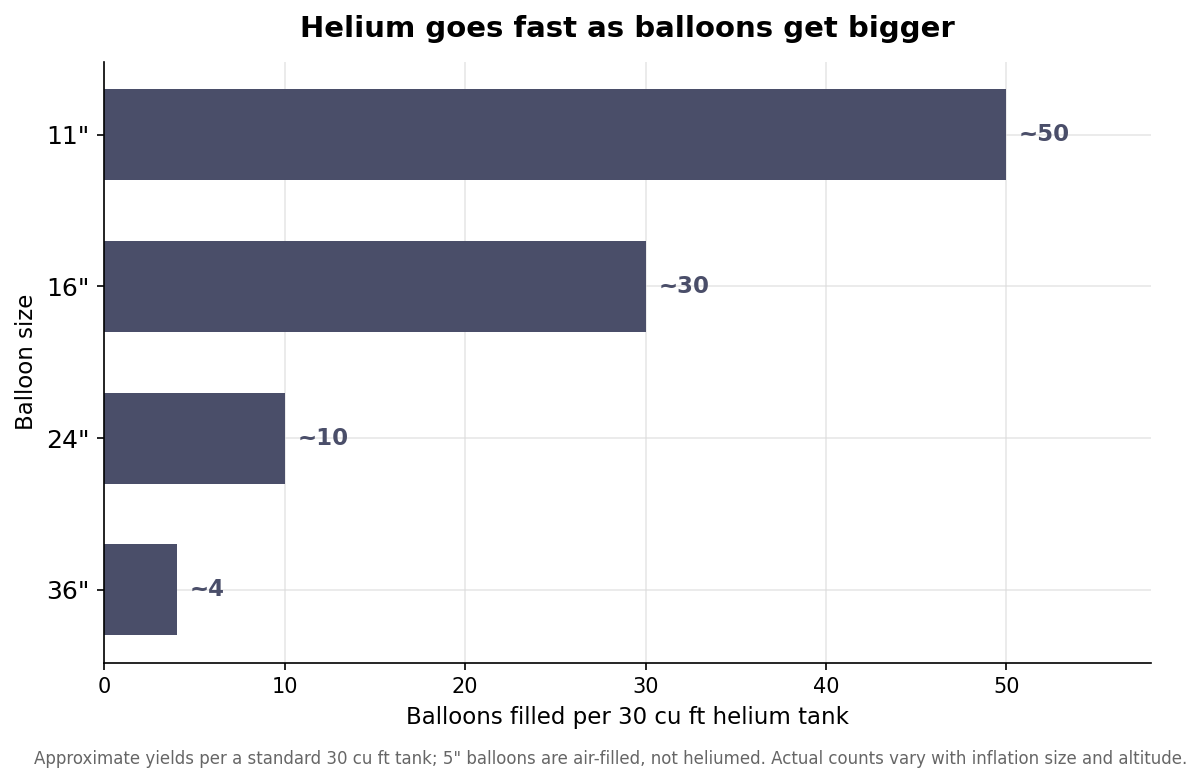
    Volume grows fast with diameter, and helium is priced by volume, so the size you pick quietly sets a big part of your fill cost. A standard 30 cubic foot helium tank fills roughly fifty 11 inch balloons, but only about thirty at 16 inches, around ten at 24 inches, and only four of the 36 inch giants. In other words, a single 36 inch balloon consumes the helium of a dozen 11 inch ones. For a large installation this is the difference between one tank and several, so it pays to decide early how many of the big statement balloons you truly need and to let smaller air-filled sizes do the volume work in garlands and walls where helium is not required at all.

    Horizontal bar chart of how many balloons a standard 30 cubic foot helium tank fills by size, from 50 at 11 inches down to 4 at 36 inches
    Larger balloons drain a helium tank far faster than small ones.

    Choosing sizes for a custom order

    Put the pieces together by working backward from the display and the budget. For a printed brand giveaway or a bouquet program, the 11 inch balloon is almost always the right base: it is the most economical to buy and fill, it holds a clean two-color logo, and most printers carry it in a wide range of standard and metallic colors with low order minimums, often in the range of a couple dozen pieces for a simple one-color job. For an installation, buy the bulk of your count in 5 and 11 inch balloons and add a smaller number of 16, 24, or 36 inch balloons as accents, which controls both helium cost and total spend while still giving the build depth. Whatever mix you land on, order against the inflated sizes and the printer’s actual imprint area, ask for a printed proof or a sample balloon before the full run, and confirm the minimum order quantity and lead time with your supplier, since both vary by size, ink count, and decoration method and are best treated as indicative until quoted.

  • How Long Balloons Actually Float

    Float time is the number most suppliers are vaguest about, and the one that decides whether an event looks finished or looks like it is packing up.

    Latex: eight to twelve hours

    An 11 inch latex balloon on plain helium gives eight to twelve hours in a normal room. Helium atoms are small enough to pass straight through natural rubber, so the balloon is losing lift from the moment it is tied.

    Heat accelerates it and cold slows it, which is why balloons inflated in a cool store room and carried into a warm hall sag faster than anybody expects. Inflate as late as you sensibly can.

    Latex with Hi-Float: two to three days

    Hi-Float is a liquid coating applied inside the balloon before inflation. It dries to a thin film that seals the pores, and it multiplies float time by roughly five.

    It has to be applied properly and it adds a little weight, so a treated balloon rises slightly less enthusiastically. For an event that starts in the evening and was set up in the morning, it is the difference between a display and a disappointment.

    Foil: two to four weeks

    Metallized nylon leaks far less than rubber, so a foil balloon holds for weeks rather than hours, and the self-sealing valve lets it be topped up when it eventually softens.

    This is why in-store displays and week-long activations use foil almost exclusively, even though the unit cost is higher than latex.

    Air-filled: a week or more, and no helium at all

    Air does not escape the way helium does, so an air-filled balloon holds its shape for a week indoors and often two weeks. It will not float, which is why air-filled work is built as garlands, arches and cup-and-stick displays rather than floating clusters.

    With many venues no longer permitting helium, this has stopped being the fallback and started being the default.

  • The Complete Buyer’s Guide to Custom Balloons

    Balloons look like the simplest thing to order and quietly are not. The material decides how long it lasts, the size decides how the artwork behaves, and almost nobody thinks about the third one until the balloons arrive.

    Here is the order to make the decisions in.

    Start with how long it has to last

    This single answer picks the material. An 11 inch latex balloon on plain helium floats eight to twelve hours — one event, one evening, and it is done. A Hi-Float coating inside the balloon seals the pores and takes that out to two or three days.

    Foil holds helium for two to four weeks because the metallized film simply leaks less. An air-filled garland has no helium in it at all and lasts a week indoors, often two weeks, which is why openings and long displays have largely moved to garlands.

    Then pick the material for what it does well

    Latex is the volume option: cheapest per piece, biodegradable, and it takes up to four spot colors across one to four print positions. It is the right answer for a giveaway.

    Foil is the precision option: full digital print, photographs and gradients, exact brand colors, and it can be die-cut to a bespoke outline. Bubble and confetti balloons are the photograph option — slower to prepare, not a giveaway, and the thing everybody at the event points a phone at.

    Size the artwork against the inflated balloon

    This is the one that catches people. Latex stretches to roughly three times its uninflated width, and a logo that filled the flat balloon ends up thin, pale and distorted across the shoulders once it is up.

    Ask for the proof at inflated scale. Fine lines, small type and tight counters are the first things to go, and simplifying them before printing costs nothing while reprinting costs everything. Foil does not have this problem, because the print goes onto a material that does not move afterwards.

    Decide the print positions

    One position is standard and reads from a single angle — fine on a table where the balloon faces the room. Two positions cover front and back.

    Four positions wrap the balloon so the mark is visible from anywhere, which is what a ceiling drop or a garland actually needs, since nobody controls which way a balloon turns.

    What to send when you ask for a quote

    Material, size, quantity, how many print positions, your colors, and the date the balloons are needed. That is enough for real pricing the same day.

    If you are not sure of the material, tell us how long the display has to stay up and the answer picks itself.

  • Building a Balloon Garland That Looks Professional

    A garland that looks bought and a garland that looks improvised differ in three specific ways, and none of them are about how many balloons you use.

    Mix at least three sizes

    A garland built from one size reads as a row. The professional look comes from mixing 5, 11 and 16 inch balloons so the outline is irregular and the eye cannot find a repeat.

    Roughly half your balloons should be the middle size, a quarter large and a quarter small. The small ones go last, tucked into the gaps the big ones leave.

    Use four colors, not two

    Pick one dominant color, two supporting tones close to it, and one accent that is genuinely different. Two colors alternating looks like bunting; four distributed unevenly looks designed.

    Double-stuffing — one balloon inside another — is how the soft chalky tones in wedding photography are made. It is a preparation technique rather than a color you can order off a chart.

    Build on a strip, and build it flat

    A decorating strip with punched holes lets you push each balloon knot through and slide it along, so the density can be adjusted as you go. Working on the floor before hanging is far easier than working at head height on a ladder.

    Glue dots hold the small filler balloons into the gaps. Two people and an hour or two will build several meters, and because it is air-filled there is no clock running while you work.

    Order about a third more than the run

    A garland that exactly matches the length it is dressing looks thin. Order roughly a third more length than the run for the dense overlapping look most people have in mind when they ask for one.

    Tell us the length you are dressing and we will do the counting, and send the balloons pre-counted by size and color so nothing has to be sorted on site.