Balloons are sold by a number printed on the bag, and almost everyone assumes that number is the size they will get. It is not. A balloon’s stated size is the diameter it reaches at full inflation, and most balloons are deliberately filled a little short of that so they keep a round shape instead of a stretched, pear-like one. If you are ordering custom balloons for an event or a brand, that gap between the label and the finished size ripples into everything downstream: how many you need, how big your logo can print, and how much helium the job will burn. This is a size-by-size guide to choosing the right balloon before you commit to a printed order.
The number on the bag is not the size you get
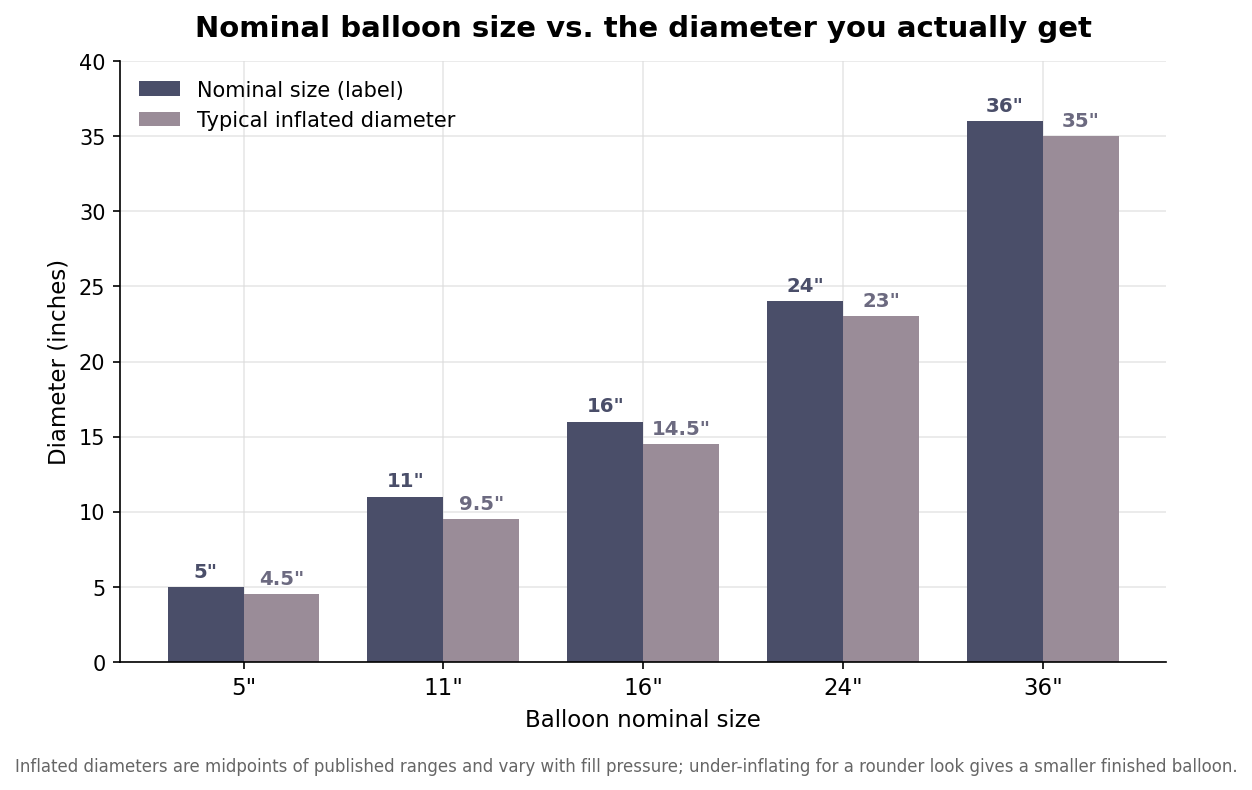
Balloons are measured at maximum inflation. An 11 inch balloon means the latex can stretch to about 11 inches across, but a well-formed 11 inch balloon is usually filled to roughly 9 to 10 inches so it stays round and durable. The same holds all the way up the range: a 5 inch balloon finishes around 4 to 5 inches, a 16 inch around 14 to 15, a 24 inch around 22 to 24, and a 36 inch giant around 34 to 36. The practical lesson is to plan your spacing, your quantities, and your backdrop coverage around the inflated size you will actually work with, not the label, because the difference between an 11 inch label and a 9 inch finished balloon adds up quickly across a wall of a few hundred.
What each size is actually for
Each size has a job it does best. Five inch balloons are fillers: they add texture and detail packed into organic garlands, balloon walls, and the gaps in an arch, and they are meant to be air-filled rather than heliumed. Eleven inch balloons are the industry standard and the most versatile choice, the default for bouquets, classic arches, and general decor, and the size most custom printers treat as their bread-and-butter for logo work. Sixteen inch balloons add dimension when mixed with smaller sizes and carry a bigger, bolder print. Twenty-four inch balloons become statement pieces for entrances, backdrops, and photo moments, while thirty-six inch giants are focal points, often filled with confetti or printed with a single large message. Mixing two or three sizes is what gives a professional installation its sense of depth; a wall built from one size reads flat.
How balloon size decides your print area
Custom printing is where size choice gets concrete for a brand. On the standard 11 inch latex balloon, a typical single-side imprint occupies about a 5 inch circular area, printed in up to two ink colors by screen or pad printing, with the option to print one or both sides. That is enough room for a logo and a short line of text, but not for dense detail, so simple, high-contrast artwork reproduces best on the curved, stretchy surface. Stepping up to a 16 inch balloon buys you a noticeably larger canvas for more elaborate logos or longer messages, which is the main reason event brands move up a size rather than for the extra height alone. Two points are worth confirming with any printer before you order: that your artwork fits their stated imprint area at the balloon size you have chosen, and how the print looks when the balloon is inflated to working size rather than fully stretched, since over-inflation distorts and lightens a printed logo.
Helium math: why bigger balloons cost more to fill
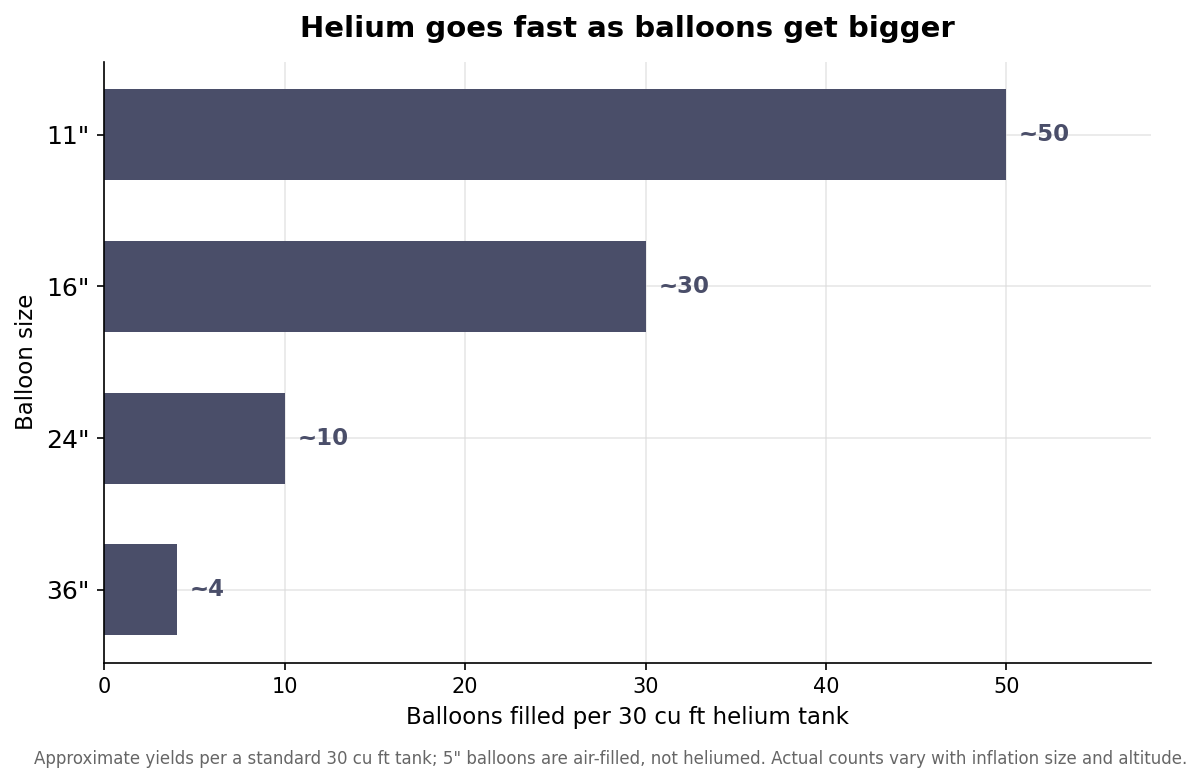
Volume grows fast with diameter, and helium is priced by volume, so the size you pick quietly sets a big part of your fill cost. A standard 30 cubic foot helium tank fills roughly fifty 11 inch balloons, but only about thirty at 16 inches, around ten at 24 inches, and only four of the 36 inch giants. In other words, a single 36 inch balloon consumes the helium of a dozen 11 inch ones. For a large installation this is the difference between one tank and several, so it pays to decide early how many of the big statement balloons you truly need and to let smaller air-filled sizes do the volume work in garlands and walls where helium is not required at all.
Choosing sizes for a custom order
Put the pieces together by working backward from the display and the budget. For a printed brand giveaway or a bouquet program, the 11 inch balloon is almost always the right base: it is the most economical to buy and fill, it holds a clean two-color logo, and most printers carry it in a wide range of standard and metallic colors with low order minimums, often in the range of a couple dozen pieces for a simple one-color job. For an installation, buy the bulk of your count in 5 and 11 inch balloons and add a smaller number of 16, 24, or 36 inch balloons as accents, which controls both helium cost and total spend while still giving the build depth. Whatever mix you land on, order against the inflated sizes and the printer’s actual imprint area, ask for a printed proof or a sample balloon before the full run, and confirm the minimum order quantity and lead time with your supplier, since both vary by size, ink count, and decoration method and are best treated as indicative until quoted.